





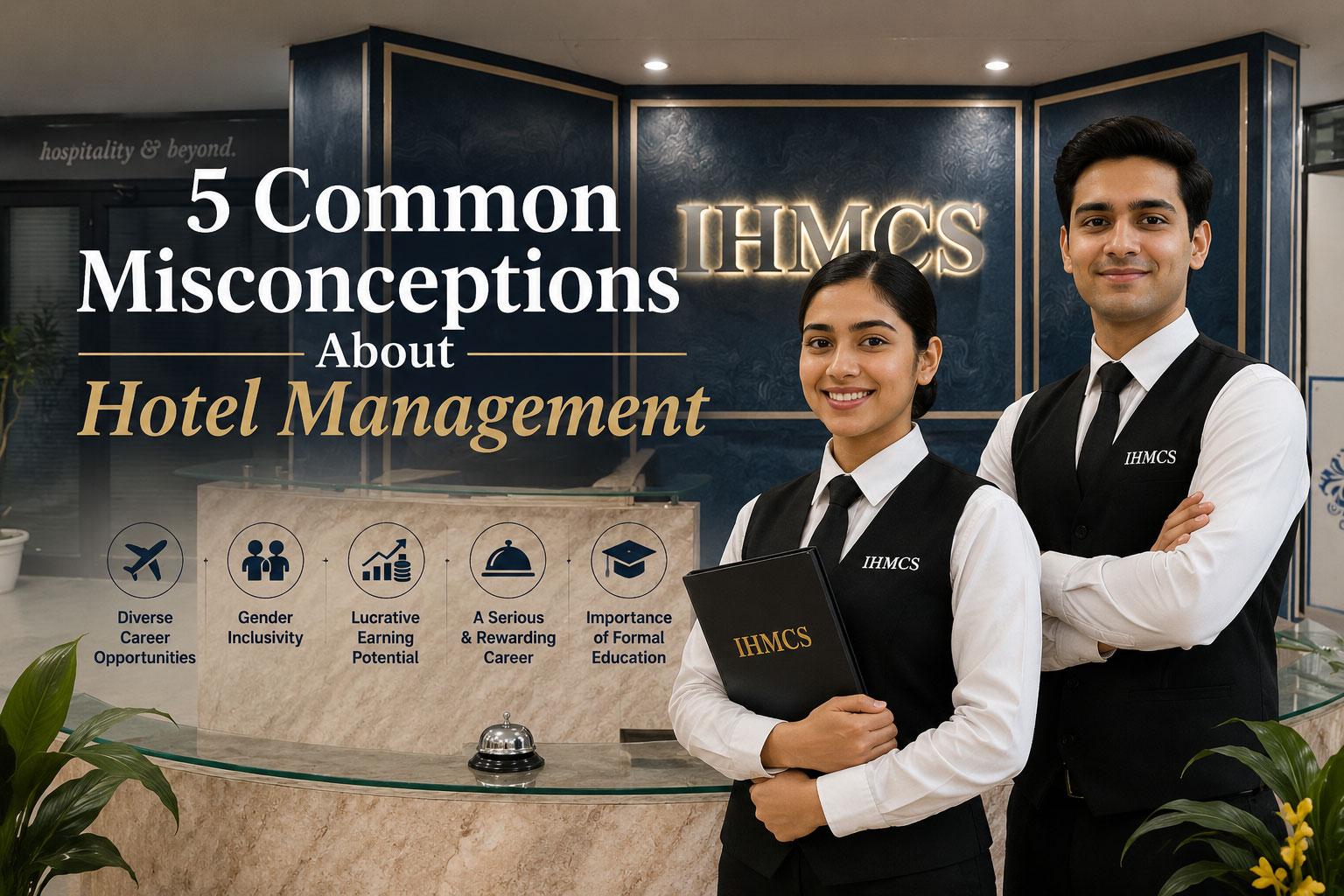
Hotel Management's 5 Common Misconceptions
Hotel Management's 5 Common Misconceptions
Choosing a career can involve difficult decisions, as today’s professional world offers many choices, and this can cause the hospitality sector to be surrounded by outdated stereotypes. Do not let false rumors stop you from studying hotel management. It is time to learn the true facts and move forward with your education.
Here are the facts behind five common myths about the hospitality industry—and how IHMCS (Institute of Hotel Management and Culinary Studies) equips you to build a successful, secure career.
Myth 1: You Will Solely Remain Confined to the Hotel Industry
The Reality: A hospitality degree is one of the most flexible business qualifications you can earn, offering many different career paths. The core skills you build—customer experience design, team management, operations, event execution, and financial planning—are in high demand across multiple sectors. Hotel management graduates thrive in:
Hotel management graduates can build careers in:
- Aviation & Cruise Lines: Cabin crew, flight operations, and luxury cruise management.
- Corporate Facilities & Retail: Managing experience centers, luxury brand outlets, and corporate operations.
- Event & Wedding Management: Organizing large-scale destination events and expos.
- Healthcare & Wellness: Patient care operations at premium hospitals and wellness resorts.
At IHMCS, our curriculum emphasizes transferable management, communication, and operational skills. While our graduates secure top roles in luxury hotel chains like Taj, Marriott, and Oberoi, they are equally prepared to pivot into aviation, event management, cloud kitchens, and luxury retail.
Myth 2: Hotel Management is More Suitable for Men Than Women
The Reality: Hospitality is an industry driven by leadership, organizational skill, emotional intelligence, and operational efficiency—areas in which women excel. Women hold prominent positions across global hotel brands as General Managers, Directors of Operations, Executive Chefs, Head Sommeliers, and Revenue Managers.
IHMCS fosters an inclusive, equal-opportunity learning environment with robust mentorship programs for women. Through tailored soft-skills training, confidence-building modules, and industry leadership workshops, we prepare students to take on high-level managerial and executive roles directly upon graduation.
Myth 3: You Won't Make Much Money Working in Hotels
The Reality: Entry-level positions in almost every industry involve a learning period, but hospitality offers rapid promotional pathways and strong long-term earning potential. Beyond base salaries, global hospitality careers come with significant perks:
- Performance bonuses, revenue sharing, and service charges.
- International relocations and tax-free earnings (especially in regions like the Middle East or on cruise ships).
- Executive-level compensation packages that compete directly with corporate business roles.
Here at IHMCS, our dedicated Placement Cell helps bridge the gap between education and income generating careers. With a strong network of domestic and international recruiting partners—including brands like Hyatt, Radisson, and IndiGo—IHMCS students regularly land competitive salary packages and fast-track executive management trainee programs.
Myth 4: Anyone Can Do Hotel Management; It’s Not a Serious Career
The Reality: Managing a 500-room luxury resort or running a high-volume culinary kitchen is a complex enterprise. It requires a blend of financial forecasting, human resources, supply chain logistics, multilingual communication, public relations, and emergency management. It is a serious management discipline that demands formal training.
IHMCS treats hospitality as the rigorous business discipline it is. We have combined 80% practical hands-on training (in state-of-the-art training kitchens, front office labs, and mock service areas) with 20% modern business theory. This balance helps our graduates enter the workforce not just as workers but as strategic managers.
Myth 5: Hotel Management Doesn't Require a Degree
The Reality: While entry-level hourly work might not require formal education, scaling the ladder to managerial, director, or executive positions demands structured higher education. A formal degree provides accredited qualifications, deep operational knowledge, financial literacy, and the recognized credentials required to work abroad or secure visas.
IHMCS offers UGC-recognized degree and diploma programmes in hotel management and Culinary Arts. Our recognized academic qualifications coupled with international training exposure give our students a distinct competitive edge that self-taught candidates cannot match.
Take the First Step with IHMCS
Outdated myths shouldn't dictate your professional future. The global hospitality industry is no longer just about shift work or routine service—it is a multi-billion-dollar global enterprise driven by leadership, business strategy, innovation, and high-value customer experience management.
When you choose a career in hotel management, you aren't just signing up for a job; you are unlocking a path toward leadership, cross-industry flexibility, international mobility, and financial success.
However, navigating this fast-evolving landscape requires more than enthusiasm—it demands the right foundation, recognized academic credentials, and continuous hands-on training.
At IHMCS, we bridge the gap between passion and professional excellence. Through our UGC-recognized degree and diploma programmes, state-of-the-art training labs, and an unbeatable network of domestic and global recruiting partners, we turn hesitant aspirants into confident industry leaders.
Your global career begins here.
Don't let misconceptions hold back your potential. Explore our industry-focused Courses at IHMCS, schedule a counseling session with our admissions team today, and take your first definitive step toward a thriving future in hospitality management.
Apply for Hotel Management Courses at IHMCS
Comments
LEAVE YOUR COMMENT